
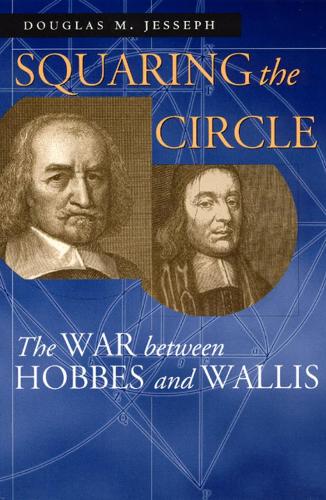
Squaring the Circle
The War between Hobbes and Wallis
This text presents an account of the argument between Thomas Hobbes and John Wallis, from the core mathematics to the broader issues. Their "battle of the books" illuminates the relationship between science and 17th-century debates over the limits of sovereign power and the existence of God.
In 1655, the philosopher Thomas Hobbes claimed he had solved the centuries-old problem of "squaring of the circle" (constructing a square equal in area to a given circle). With a scathing rebuttal to Hobbes's claims, the mathematician John Wallis began one of the longest and most intense intellectual disputes of all time. This book presents an account of the controversy, from the core mathematics to the broader philosophical, political and religious issues at stake. Hobbes believed that by recasting geometry in a materialist mold, he could solve any geometric problem and thereby demonstrate the power of his materialist metaphysics. Wallis, a prominent Presbyterian divine as well as an eminent mathematician, refuted Hobbes's geometry as a means of discrediting his philosophy, which Wallis saw as a dangerous mix of atheism and pernicious political theory. Hobbes and Wallis's "battle of the books" illuminates the intimate relationship between science and crucial 17th-century debates over the limits of sovereign power and the existence of God.
The War between Hobbes and Wallis
This text presents an account of the argument between Thomas Hobbes and John Wallis, from the core mathematics to the broader issues. Their "battle of the books" illuminates the relationship between science and 17th-century debates over the limits of sovereign power and the existence of God.
In 1655, the philosopher Thomas Hobbes claimed he had solved the centuries-old problem of "squaring of the circle" (constructing a square equal in area to a given circle). With a scathing rebuttal to Hobbes's claims, the mathematician John Wallis began one of the longest and most intense intellectual disputes of all time. This book presents an account of the controversy, from the core mathematics to the broader philosophical, political and religious issues at stake. Hobbes believed that by recasting geometry in a materialist mold, he could solve any geometric problem and thereby demonstrate the power of his materialist metaphysics. Wallis, a prominent Presbyterian divine as well as an eminent mathematician, refuted Hobbes's geometry as a means of discrediting his philosophy, which Wallis saw as a dangerous mix of atheism and pernicious political theory. Hobbes and Wallis's "battle of the books" illuminates the intimate relationship between science and crucial 17th-century debates over the limits of sovereign power and the existence of God.
Description
The War between Hobbes and Wallis
This text presents an account of the argument between Thomas Hobbes and John Wallis, from the core mathematics to the broader issues. Their "battle of the books" illuminates the relationship between science and 17th-century debates over the limits of sovereign power and the existence of God.
In 1655, the philosopher Thomas Hobbes claimed he had solved the centuries-old problem of "squaring of the circle" (constructing a square equal in area to a given circle). With a scathing rebuttal to Hobbes's claims, the mathematician John Wallis began one of the longest and most intense intellectual disputes of all time. This book presents an account of the controversy, from the core mathematics to the broader philosophical, political and religious issues at stake. Hobbes believed that by recasting geometry in a materialist mold, he could solve any geometric problem and thereby demonstrate the power of his materialist metaphysics. Wallis, a prominent Presbyterian divine as well as an eminent mathematician, refuted Hobbes's geometry as a means of discrediting his philosophy, which Wallis saw as a dangerous mix of atheism and pernicious political theory. Hobbes and Wallis's "battle of the books" illuminates the intimate relationship between science and crucial 17th-century debates over the limits of sovereign power and the existence of God.