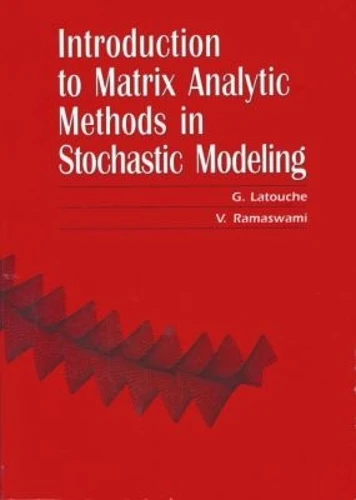
Introduction to Matrix Analytic Methods in Stochastic Modeling
The authors present the basic mathematical ideas and algorithms of the matrix analytic theory in a readable, up-to-date, and comprehensive manner. Many new proofs that emphasize the unity of the matrix analytic approach are included.
Matrix analytic methods are popular as modeling tools because they give one the ability to construct and analyze a wide class of queuing models in a unified and algorithmically tractable way. The authors present the basic mathematical ideas and algorithms of the matrix analytic theory in a readable, up-to-date, and comprehensive manner. In the current literature, a mixed bag of techniques is used—some probabilistic, some from linear algebra, and some from transform methods. Here, many new proofs that emphasize the unity of the matrix analytic approach are included.
The authors begin by describing several examples of quasi-birth-and-death (QBD) processes. These examples give the reader an idea of the variety of models which are hidden by the general block notation as well as reinforce some of the terminology and notation used throughout the text. These same examples are used as illustrations later. The second part of the book deals with phase-type distributions and related-point processes, which provide a versatile set of tractable models for applied probability. Part three reviews birth-and-death processes, and points out that the arguments for these processes carry over to more general processes in a parallel manner and are based on Markov renewal theory.
Part four covers material where algorithmic and probabilistic reasoning are most intimately connected. In three steps, the authors take you from one of the simplest iterative procedures to the fastest, relating the successive approximations to the dynamic behavior of the stochastic process itself. The final part goes beyond simple QBDs with a sequence of short chapters where the authors discuss various extensions to the analyzed processes. Their intention is to show that the fundamental ideas extend beyond simple homogeneous QBD.
The authors present the basic mathematical ideas and algorithms of the matrix analytic theory in a readable, up-to-date, and comprehensive manner. Many new proofs that emphasize the unity of the matrix analytic approach are included.
Matrix analytic methods are popular as modeling tools because they give one the ability to construct and analyze a wide class of queuing models in a unified and algorithmically tractable way. The authors present the basic mathematical ideas and algorithms of the matrix analytic theory in a readable, up-to-date, and comprehensive manner. In the current literature, a mixed bag of techniques is used—some probabilistic, some from linear algebra, and some from transform methods. Here, many new proofs that emphasize the unity of the matrix analytic approach are included.
The authors begin by describing several examples of quasi-birth-and-death (QBD) processes. These examples give the reader an idea of the variety of models which are hidden by the general block notation as well as reinforce some of the terminology and notation used throughout the text. These same examples are used as illustrations later. The second part of the book deals with phase-type distributions and related-point processes, which provide a versatile set of tractable models for applied probability. Part three reviews birth-and-death processes, and points out that the arguments for these processes carry over to more general processes in a parallel manner and are based on Markov renewal theory.
Part four covers material where algorithmic and probabilistic reasoning are most intimately connected. In three steps, the authors take you from one of the simplest iterative procedures to the fastest, relating the successive approximations to the dynamic behavior of the stochastic process itself. The final part goes beyond simple QBDs with a sequence of short chapters where the authors discuss various extensions to the analyzed processes. Their intention is to show that the fundamental ideas extend beyond simple homogeneous QBD.
Original: $169.54
-70%$169.54
$50.86Description
The authors present the basic mathematical ideas and algorithms of the matrix analytic theory in a readable, up-to-date, and comprehensive manner. Many new proofs that emphasize the unity of the matrix analytic approach are included.
Matrix analytic methods are popular as modeling tools because they give one the ability to construct and analyze a wide class of queuing models in a unified and algorithmically tractable way. The authors present the basic mathematical ideas and algorithms of the matrix analytic theory in a readable, up-to-date, and comprehensive manner. In the current literature, a mixed bag of techniques is used—some probabilistic, some from linear algebra, and some from transform methods. Here, many new proofs that emphasize the unity of the matrix analytic approach are included.
The authors begin by describing several examples of quasi-birth-and-death (QBD) processes. These examples give the reader an idea of the variety of models which are hidden by the general block notation as well as reinforce some of the terminology and notation used throughout the text. These same examples are used as illustrations later. The second part of the book deals with phase-type distributions and related-point processes, which provide a versatile set of tractable models for applied probability. Part three reviews birth-and-death processes, and points out that the arguments for these processes carry over to more general processes in a parallel manner and are based on Markov renewal theory.
Part four covers material where algorithmic and probabilistic reasoning are most intimately connected. In three steps, the authors take you from one of the simplest iterative procedures to the fastest, relating the successive approximations to the dynamic behavior of the stochastic process itself. The final part goes beyond simple QBDs with a sequence of short chapters where the authors discuss various extensions to the analyzed processes. Their intention is to show that the fundamental ideas extend beyond simple homogeneous QBD.